Bites Uses ChatGPT to Rethink Food Delivery
Discover how Bites uses ChatGPT for direct restaurant ordering, its flat $1 surcharge, and what AI agents could mean for food delivery.
Source: https://www.theverge.com/ai-artificial-intelligence/1005726/doordash-ai-agentic-food-delivery-bites
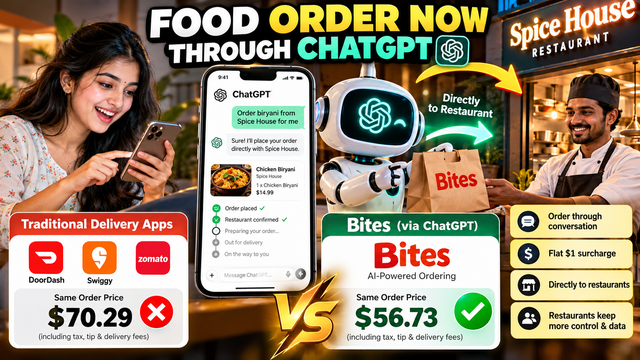
Bites Is Using ChatGPT to Rethink Food Delivery: What Happens When AI Becomes the Middleman?
Introduction: The Next Big Change in Food Ordering
For years, ordering food online has followed a familiar process. Customers open a delivery app, search for a restaurant, browse menus, add dishes to a cart, pay service fees, and wait for delivery. Restaurants depend on these platforms to reach customers, but commissions and other costs can put pressure on their profits.
Now, a new approach is emerging: what if customers could order food through an AI conversation instead of navigating a traditional delivery app?
That is the idea behind Bites, a startup using conversational AI to help customers order from participating restaurants through ChatGPT. Instead of treating a conventional food-delivery marketplace as the main destination, Bites aims to connect customers and restaurants through an AI-powered ordering experience.
The concept could have implications beyond food. It raises a bigger question for the technology industry: if AI assistants become the place where people search, compare, and purchase products, what happens to the apps and websites that currently control those interactions?
1. What Is Bites?
Bites is an AI-powered food-ordering startup operating in the San Francisco Bay Area. Its approach allows customers to interact with an AI assistant and place orders from participating restaurants.
The important difference is the ordering interface. Rather than manually navigating multiple screens, a customer can express what they want in natural language.
For example, a customer might ask for a chicken biryani from a nearby restaurant, specify a budget, or describe a meal they would like to order. A conversational interface can make the process feel more like speaking to an assistant than filling out a traditional online shopping form.
The underlying business idea is to reduce reliance on conventional delivery marketplaces for the ordering process.
However, Bites should not be confused with a universal food-ordering feature available to every ChatGPT user. Its service has been described as a small, geographically limited startup offering access to participating restaurants. Availability and supported ordering options depend on its actual service coverage.
2. How Does AI-Powered Food Ordering Work?
The traditional food-delivery process generally begins with an app. Customers search for restaurants, compare menu items, check prices, and place an order.
An AI-powered model changes the way customers interact with the system.
Here is a simplified explanation:
Step 1: The customer explains what they want.
A person describes the meal they are looking for using ordinary language. They might request vegetarian food, a particular cuisine, or a meal within a certain budget.
Step 2: The AI helps interpret the request.
The conversational system processes the customer's preferences and helps identify a suitable ordering option where the service supports it.
Step 3: The ordering service connects to the restaurant.
The service facilitates the order through its supported restaurant-ordering process. The goal is to send orders to participating restaurants rather than requiring every transaction to follow the traditional marketplace model.
Step 4: The restaurant handles the order.
The restaurant receives the order and prepares it, subject to its own availability and operating procedures.
Step 5: The customer receives the food.
Delivery arrangements, fees, estimated arrival times, and order tracking depend on the service's capabilities and the restaurant's arrangements.
The broader model can be represented as:
Customer → AI assistant → Ordering service → Restaurant
This illustrates the central idea: AI becomes the interface through which a customer discovers and orders a product.
3. Why Is Bites Challenging Traditional Delivery Apps?
Traditional delivery marketplaces provide valuable services. They help customers discover restaurants, compare menus, pay online, and arrange delivery. They also invest in customer acquisition, technology, logistics, and support.
But these services can be expensive.
Marketplace commission structures can affect how restaurants price their menu items and how much money they retain from each order. Restaurants may also have concerns about customer ownership, access to customer information, and their dependence on a third-party platform.
Bites presents an alternative approach that attempts to simplify the commercial relationship.
According to The Verge's October 7, 2026 report, Bites uses a flat $1 surcharge per order under its reported pricing model, rather than relying on the conventional percentage-based restaurant commission model.
A flat fee and a percentage-based commission operate differently.
With a percentage-based model, the fee can rise as the value of an order increases. With a flat-fee model, the stated surcharge stays fixed per order, although other costs may still apply.
This difference could be attractive to restaurants that want greater control over their pricing and margins.
It does not automatically mean that every order will be cheaper. The final amount depends on menu prices, taxes, tips, delivery costs, and any other applicable fees.
4. The Price Comparison That Attracted Attention
One of the most interesting details in The Verge's report was a comparison of the same food order through Bites and DoorDash.
The reported totals were:
Bites: $56.73
DoorDash: $70.29
Both totals included tax, tip, and delivery fees.
The difference was $13.56 for that particular order.
That is a meaningful difference for a customer, especially if similar savings are available consistently. For a restaurant receiving many orders, the economics of different commission structures could also matter.
However, it is important to understand what this comparison does and does not prove.
It demonstrates that one tested order cost less through Bites than through DoorDash under the circumstances described in the report. It does not establish that Bites will always be cheaper, that every restaurant will offer the same prices, or that customers in every location can access the service.
For creators discussing this story, the fairest headline is not that AI has permanently made food delivery cheaper. It is that AI-powered ordering is testing a different business model that could change how ordering fees are structured.
5. What Could Restaurants Gain?
Restaurants are among the businesses most directly affected by the economics of online ordering.
A restaurant may attract customers through a large delivery platform, but the cost of acquiring those orders can reduce its earnings. A direct-ordering approach could provide another way to reach customers without depending entirely on a single marketplace.
There are several potential advantages.
Greater control over pricing: Restaurants may have more flexibility to determine menu prices when the commercial arrangement differs from a conventional commission-based marketplace.
A different cost structure: A flat surcharge can make the ordering fee easier to understand, although restaurants must still account for their other operating expenses.
Closer customer relationships: Direct or alternative ordering channels can give restaurants more opportunities to develop relationships with repeat customers.
Less dependence on one platform: Multiple ordering channels may help businesses avoid relying exclusively on a single company for online visibility and orders.
More flexibility for small businesses: Independent restaurants may be interested in tools that simplify online ordering without requiring them to build a sophisticated ordering system from scratch.
These benefits are potential advantages, not guaranteed results. Restaurants must also consider customer reach, technical reliability, order accuracy, delivery operations, and support.
6. Why Customer Data and Restaurant Relationships Matter
An online marketplace does more than process transactions. It also controls important parts of the customer experience, including restaurant discovery, recommendations, promotions, and repeat purchases.
This creates a strategic advantage for the platform.
When customers repeatedly open the same application to find food, the platform becomes the place where customer attention is concentrated. Restaurants may compete for visibility within that environment.
An AI-first ordering model could change this relationship.
If customers increasingly discover businesses through an assistant, the assistant may become the primary interface for searching and making decisions. The ordering service and restaurant would then need to establish how customer preferences, order history, and communication are handled.
For restaurants, access to useful customer information could help with repeat orders and customer service. For customers, conversational ordering could reduce the effort involved in finding familiar meals.
But customer data must be handled responsibly. Businesses should understand what information is collected, who can access it, how it is used, and whether customers have meaningful choices over its use.
The shift toward AI ordering will therefore involve questions of privacy and control as well as price.
7. The Bigger Trend: AI Agents Are Becoming Action-Taking Assistants
Bites is an example of a broader development in artificial intelligence: the move from systems that mainly answer questions to systems that help users complete tasks.
A conventional chatbot might recommend restaurants or suggest what to eat. A more action-oriented system attempts to help carry out the next step, such as selecting an option and facilitating an order through an integrated service.
This is part of the wider idea of AI agents.
An AI agent can use instructions, tools, and connected services to work toward a goal. Depending on its permissions and integrations, it may be able to search for information, organise tasks, interact with software, or initiate transactions.
The important distinction is that generating a recommendation is not the same as completing a transaction.
A real ordering system must handle practical details such as menu accuracy, price changes, payment, restaurant availability, delivery arrangements, and confirmation. It also needs safeguards so that an AI does not place an unintended order or act without appropriate permission.
Food ordering is a useful example because it involves a familiar task with a measurable outcome: the customer either receives the correct meal at the agreed price or does not.
8. Could This Model Work in India?
India is an interesting market to consider because food ordering is already a common digital activity and the restaurant sector includes large chains as well as independent businesses.
However, Bites' reported Bay Area service should not be presented as a nationwide Indian launch. The business opportunity in India is a possible future application of the underlying idea, not proof that this specific service is currently available across the country.
Imagine an Indian customer asking an AI assistant:
"I want vegetarian dinner for two under ₹500. Find nearby restaurants and show the final price before I confirm."
A capable system could help compare suitable options, explain delivery fees, and present the order for confirmation. If it had reliable integrations with restaurants and payment systems, it might help complete the transaction too.
For this model to work well in India, several practical requirements would matter:
Accurate menus and prices in local markets.
Support for Indian payment methods.
Reliable delivery and order-status updates.
Regional language support.
Clear handling of food preferences and allergy information.
Transparent pricing and explicit customer confirmation.
Agreements with restaurants that define responsibilities and data access.
There is also an opportunity for Indian developers and entrepreneurs to build specialised AI ordering tools for local restaurants, bakeries, cafés, grocery stores, and other small businesses.
The opportunity is real enough to investigate, but commercial success would depend on execution, customer trust, restaurant participation, and economics.
9. Business Opportunities for Developers and Entrepreneurs
The lesson from Bites is not simply that every business should add a chatbot to its website. The more important question is whether AI can make an existing customer journey easier or less expensive.
For example, a developer could explore an assistant that helps customers find products from a local retailer. A café could test a conversational menu that answers questions about ingredients and takes confirmed orders. A small business could automate frequently asked questions before handing a complex request to a human employee.
These ideas share a common structure:
First, identify a repetitive customer task. Next, determine which parts can be automated safely. Then connect the assistant to accurate business information and the systems needed to complete the task. Finally, measure whether the experience actually saves time, reduces costs, or improves customer satisfaction.
Businesses should not adopt AI only because it is trending. They should evaluate whether the tool solves a genuine problem.
They must also account for integration costs, maintenance, incorrect outputs, privacy, and the need for human support when something goes wrong.
10. What Are the Risks and Limitations?
AI-powered ordering is promising, but it introduces challenges.
Incorrect information: An assistant may present an outdated menu, an incorrect price, or an unavailable item if the underlying information is not kept current.
Accidental purchases: Systems need clear confirmation steps before placing orders or charging a customer.
Restaurant consent: Businesses should know whether they are listed on a service and have clear ways to correct information or raise concerns.
Customer support: Someone must resolve missing items, late deliveries, refunds, and payment problems.
Delivery logistics: Making an order conversational does not automatically solve the physical challenge of getting food to the customer.
Privacy and security: Ordering systems must protect personal information and payment-related data.
Limited availability: A startup with a small restaurant network cannot automatically replace major delivery services across every city.
Business sustainability: A low fee may appeal to users, but the company still needs a sustainable way to pay for technology, operations, support, and growth.
These limitations explain why the future is unlikely to be determined by conversational interfaces alone. The strongest services will need reliable operations and good economics alongside convenient AI.
11. What Should Creators and Students Learn From This News?
For students interested in computer science, artificial intelligence, or entrepreneurship, Bites provides a practical example of how software can influence an established industry.
It connects several important concepts: natural-language processing, AI agents, application integrations, digital commerce, business models, and customer experience.
Students can use this example to understand the difference between building an AI demonstration and developing a product that people can trust with real transactions.
For content creators, the story offers a clear way to explain an otherwise technical concept. Instead of discussing AI agents only in abstract terms, creators can show how a person might order a meal through a conversation and compare the business models involved.
For entrepreneurs, the key question is where customers currently experience unnecessary friction and whether an AI assistant could remove it.
A useful project might start with a simple restaurant FAQ assistant before progressing to menu search and confirmed ordering. Each stage should be tested for accuracy, safety, and genuine user benefit.
Conclusion: Could AI Become the New Food-Ordering Interface?
Bites is testing a different approach to food ordering: letting customers use a conversational AI interface to order from participating restaurants while challenging the economics of traditional delivery marketplaces.
The reported $56.73 versus $70.29 comparison shows why the idea has attracted attention, although it represents one order rather than a universal price advantage.
The larger story is about who controls the customer journey. If AI assistants become a common way to discover products and complete everyday tasks, businesses may need to rethink how customers find them, how transactions happen, and how ordering costs are shared.
Traditional delivery apps still offer important services, including discovery, logistics, and customer support. An AI ordering interface must deliver comparable reliability before it can replace those functions at scale.
For now, Bites is an early example of a possible shift rather than proof that food-delivery apps are about to disappear.
The most important question is no longer whether AI can recommend dinner. It is whether AI can help customers complete the entire process reliably, transparently, and at a price that works for both customers and businesses.
Source: The Verge, October 7, 2026, “AI could upend food delivery.”