Audionaut Lets AI Agents Edit Audio Projects Directly
Audionaut is a free open-source audio editor that lets Claude and other MCP-capable AI agents edit multitrack projects through natural-language instructions.
Source: https://audionaut.app/
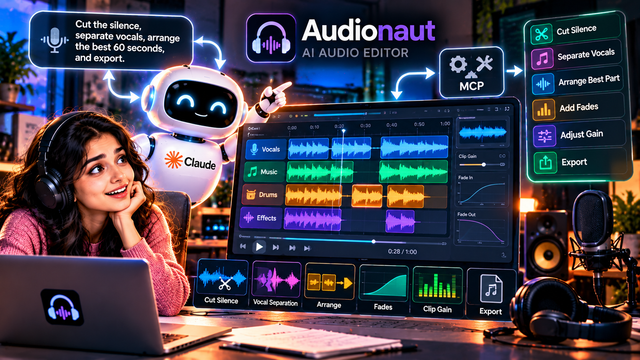
Audionaut Lets AI Agents Edit Audio Projects Directly
AI agents are moving beyond answering questions and generating text. A new open-source audio editor called Audionaut lets AI assistants such as Claude directly inspect and modify multitrack audio projects through the Model Context Protocol, or MCP.
Audionaut is a free, open-source desktop application designed for audio recording, editing and arranging. It runs on Windows, macOS and Linux and provides tools for cutting, arranging, fades, clip gain, analysis, stem separation and exporting audio.
What makes the project interesting is its integration with AI agents. Instead of manually performing every edit on a timeline, users can give an AI assistant instructions in natural language. For example, a creator could ask an agent to split a track at a specific point, create sections, arrange clips, add fades or build a shorter arrangement.
The MCP integration exposes Audionaut's editing capabilities as tools that compatible AI agents can call. This creates a workflow where the AI understands the instruction, calls the appropriate tool and sends the resulting edit into the audio project.
One particularly useful feature is the undo workflow. When a project is open in Audionaut, each agent command can arrive as a separate undo step. This means creators can review what the AI changed and reverse individual edits instead of having to accept one large automated modification. Audionaut also says that the open-project workflow does not automatically overwrite the project file, leaving saving under the user's control.
Audionaut can also perform tasks beyond basic cutting. Its documented capabilities include arranging regions, applying fades, changing clip gain, analyzing audio, using Auto Edit, separating stems and exporting finished audio.
This creates an important shift in creative software:
AI → understands the instruction → calls an MCP tool → edits the timeline → human reviews → undo or save
For creators, this could make repetitive audio editing much faster. A podcast creator could ask an agent to organize sections, a musician could experiment with arrangements, and a video creator could prepare audio clips for short-form content.
The bigger trend is not simply “AI can edit audio.” It is that AI agents are beginning to operate inside professional creative applications instead of only generating suggestions in a chat window.
Audionaut is therefore an interesting example of how MCP could connect conversational AI with real creative workflows while keeping the human creator in control of the final project.