Anthropic’s Claude AI Misuse Report: 154 Pages of Alarming
Anthropic’s September 2026 threat report documents attempts to misuse Claude for cyberattacks, surveillance, weapons
By @admin
Source: https://www.anthropic.com/threat-intelligence-report-september-2026?utm_source=chatgpt.com
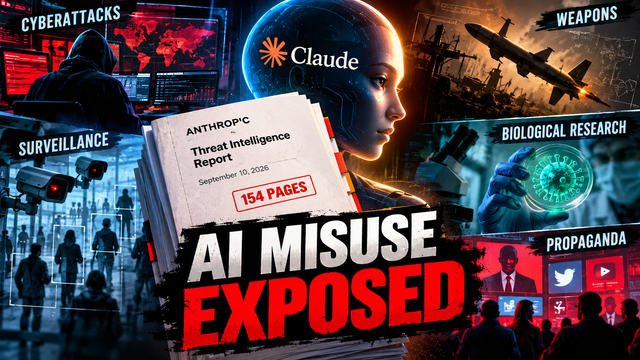
Anthropic’s 154-Page Report Reveals Real-World AI Misuse Attempts
Artificial intelligence is becoming more powerful every month. But what happens when people use these capabilities for cyberattacks, surveillance, weapons development, biological research, and large-scale propaganda?
On September 10, 2026, Anthropic published a 154-page threat-intelligence report documenting real-world attempts to misuse its AI assistant, Claude. The report covers investigations conducted between December 2025 and August 2026 and describes how different actors attempted to use AI for harmful activities. Anthropic says it disrupted the identified operations, banned associated accounts, strengthened its safeguards, and shared intelligence with relevant partners where appropriate.
This is an important development in the AI industry because it moves the conversation beyond hypothetical risks. The report describes actual investigations into how people attempted to use an advanced AI system for activities that could harm individuals, businesses, and governments.
1. What Did Anthropic Actually Discover?
Anthropic’s report examines several categories of suspected misuse, including cyber operations, influence campaigns, surveillance, scams and fraud, biological misuse, conventional weapons development, and attempts to extract AI capabilities for training other models.
The important distinction is that these were not all the same kind of threat. Some involved criminal activity, while others involved suspected state-linked actors, commercial operators, or individuals pursuing political or military objectives.
According to Anthropic, the investigations revealed that AI could help people perform complex tasks faster, organize large amounts of information, and produce technical material that would otherwise require more time or specialized expertise.
However, the report should not be interpreted as proof that every attempt succeeded. Some activities were blocked, some were disrupted during development, and the maturity and real-world impact of individual operations varied.
The central concern is that increasingly capable AI tools can be misused by people with very different levels of technical expertise.
2. Cyberattacks: AI Is Becoming More Than a Chatbot
One of the report’s most significant areas is AI-assisted cyber operations.
Traditionally, sophisticated cyberattacks could require multiple specialists to conduct research, analyze information, develop software, and coordinate different stages of an operation. AI can help automate parts of this work, potentially reducing the time and expertise required.
Anthropic describes cases in which malicious actors used Claude to assist with technical work across cyber operations. The report also highlights a broader shift: AI is increasingly being used within automated workflows rather than only through isolated questions and answers.
This matters because an AI assistant connected to tools can potentially do more than explain a concept. Depending on its permissions, it may be able to analyze files, interact with software, execute approved operations, or coordinate multiple tasks.
That does not mean AI independently carries out every attack. Human operators can still choose targets, direct activities, and review results. The danger comes from the combination of human intent, AI assistance, and access to powerful tools.
For businesses, this reinforces the need for stronger account security, access controls, monitoring, and incident response systems. For developers, it demonstrates why AI agents must be designed with security restrictions from the beginning.
3. Surveillance: When AI Makes Monitoring Easier
Another major concern is the use of AI for surveillance and the analysis of personal information.
AI systems can help organize large datasets, summarize records, analyze video, and identify patterns across information that would otherwise take considerable time to review manually.
These capabilities can support legitimate applications, including finding missing people, improving public safety, and managing security incidents. But they can also be abused to monitor individuals without appropriate authorization.
Anthropic’s report describes investigations involving surveillance-related activity and attempts to identify or monitor people. It also discusses the risks of sensitive information being processed through AI services without users fully understanding where their data is going.
The problem is not simply that an AI model can analyze information. It is that the same capability can be used for very different purposes depending on who controls it, what data it receives, and what actions it is permitted to take.
For businesses and developers, the lesson is straightforward: sensitive data should not be sent to AI systems without appropriate authorization, privacy protections, and a clear understanding of the service being used.
4. Weapons Development: The Risks Go Beyond Digital Threats
The report also documents attempts to use Claude in work related to conventional weapons.
Anthropic describes investigations involving software and technical assistance associated with weapons development, military systems, and related intelligence gathering. Some cases involved efforts to develop or evaluate systems using software and simulations.
This is an important distinction in discussions about AI safety. The risks are not limited to misinformation or malicious software. AI can also assist with technical work in physical-world applications.
At the same time, the existence of AI-assisted research does not automatically prove that a functioning weapon was successfully developed or deployed. Each case needs to be evaluated according to the evidence and the level of technical progress documented.
For AI developers, the challenge is to identify requests that cross from legitimate education or research into assistance that could enable serious harm.
For users, it is a reminder that AI capabilities should be evaluated not only by what a model can generate, but also by how that output could be used in the real world.
5. Biological Research: Why the Findings Need Careful Attention
Biological research is another sensitive area discussed in the report.
Anthropic describes five notable biological-research cases. One investigation involved a funding proposal concerning research on chikungunya virus, including proposed work related to transmissibility and immune evasion. The company said the request triggered its safety systems and led to further investigation.
Biological research can have substantial public benefits. Scientists use advanced computational tools to study diseases, understand how pathogens behave, develop diagnostics, and improve treatments and vaccines.
But some forms of biological research can also create risks if they are designed or conducted in ways that increase a pathogen’s harmful properties.
This creates a difficult challenge for AI companies. A system should support legitimate scientific education and beneficial research without providing assistance that meaningfully enables dangerous biological misuse.
Anthropic’s report describes how investigators examined the surrounding circumstances, including the research context and attempts to bypass restrictions.
The broader lesson is that safety decisions cannot always rely on a single keyword. Context, user intent, requested assistance, and the potential consequences of the work all matter.
These cases also show why AI safety systems need ongoing evaluation. Blocking one request is not necessarily enough if someone can simply change accounts, use intermediaries, or move the same request to another service.
6. Propaganda and Fake Online Identities
The report also examines influence operations: activities intended to manipulate public opinion or political discussion through deceptive or coordinated communication.
AI can make it easier to produce large quantities of text, generate fictional personas, translate content, and prepare material for different audiences.
These capabilities can be useful for legitimate communication. However, malicious actors can use similar tools to create fake online identities, publish misleading claims, or make coordinated campaigns appear to represent genuine public opinion.
The danger is not just the amount of content produced. It is the possibility that artificial activity may be mistaken for authentic human participation.
For example, a coordinated network of fake accounts could give the false impression that a particular claim has widespread public support. If the identities and relationships behind those accounts are concealed, ordinary users may struggle to distinguish genuine discussion from manipulation.
This is particularly relevant in the age of AI-generated videos, synthetic voices, and realistic images.
For creators and audiences in India, the practical response is to verify important claims, check original sources, and avoid sharing sensational content solely because it appears convincing or receives high engagement.
AI-generated content is not automatically false, just as human-created content is not automatically trustworthy. Evidence and context matter more than appearance.
7. Did Anthropic Stop Every Attempt?
No. That would be an inaccurate interpretation of the report.
Anthropic says it identified and disrupted the operations described in its investigations. It also says it banned associated accounts and improved its safeguards.
But detecting misuse is an ongoing process. A company may block one account while an actor attempts to return through another account, a third-party service, or a different technical route.
The report illustrates why safety enforcement is more complicated than adding a list of prohibited words to a chatbot.
Effective safeguards require several layers: identifying suspicious activity, investigating context, restricting dangerous requests, limiting access to sensitive tools, responding to attempts to bypass restrictions, and learning from previous incidents.
There is also an important limitation to remember: Anthropic is reporting on its own investigations into activity involving its services. Its report offers valuable evidence about the cases it identified, but it is not a complete measurement of all AI misuse across every company or platform.
That distinction matters when interpreting the findings.
8. What Does This Mean for AI Creators, Students, and Businesses in India?
For Indian AI creators, the report is a reminder that powerful tools come with responsibilities.
Creators can continue using AI for video production, editing, research, automation, storytelling, and marketing. The key is to use these capabilities responsibly, respect privacy, verify factual claims, and avoid creating deceptive content that could harm others.
Students should focus on understanding how AI systems work, how to evaluate their outputs, and how to build secure applications. Learning cybersecurity, automation, and AI development is valuable when practiced within authorized environments.
Businesses using AI agents should pay particular attention to permissions. An agent that can read files, access customer records, send messages, or execute transactions should not receive unrestricted access by default.
A practical safety workflow can look like this:
User request → Risk classifier → Policy check → Restricted tool access → Execution monitoring → Audit log → Human escalation when necessary.
First, the system evaluates the request for potential risks. Next, it checks whether the task is permitted. If it is approved, the agent receives only the tools and permissions needed for that task. Actions are monitored and recorded, and sensitive or ambiguous cases can be sent to a human reviewer.
For example, an AI marketing agent might be allowed to draft Instagram captions and summarize public campaign metrics. It should not automatically receive permission to export all customer data, send bulk messages, or change payment settings.
This approach allows businesses to benefit from automation without treating every AI-generated action as inherently safe.
9. The Bigger Picture: AI Safety Must Keep Improving
The most important lesson from Anthropic’s report is not that AI should be abandoned. It is that increasingly capable AI systems need safeguards that evolve alongside their capabilities.
AI can help students learn, creators produce better content, developers build software, researchers analyze information, and businesses automate repetitive work. Those benefits are real.
But the same underlying capabilities can create risks when used with malicious intent or without appropriate oversight.
Companies developing advanced models need to invest in detection, evaluation, secure tool access, and incident response. Governments, researchers, and independent security experts also have a role in evaluating emerging threats and developing effective safeguards.
Transparency is another important issue. Publishing threat-intelligence findings can help other organizations recognize similar patterns and improve their own defenses. At the same time, reports must balance public accountability with the need to avoid publishing operational details that could make harmful activity easier to reproduce.
For the public, the right response is neither blind trust nor unnecessary panic. It is to understand the evidence, ask questions, and support responsible development.
Final Takeaway
Anthropic’s September 2026 report provides a detailed account of attempts to misuse Claude across several high-risk areas. It highlights how AI can assist complex activities, how safeguards can be challenged, and why detecting and disrupting misuse requires continuous work.
The central question is no longer just what AI can do. It is also who can use it, what permissions they receive, what safeguards exist, and how quickly misuse can be detected and addressed.
As AI agents become more capable, responsible access controls and transparent security practices will become increasingly important.
What do you think? Should AI companies publicly disclose every serious misuse attempt, or could too much transparency help malicious actors? Share your opinion.