Anthropic Launches Claude for Manufacturing AI
Anthropic has introduced Claude for Manufacturing, a new AI plugin featuring 17 specialized skills and four enterprise connectors to help factories improve quoting, quality checks, maintenance diagnosis, supplier management, and production reporting.
By Gangothri
Source: https://www.anthropic.com/news/claude-for-manufacturing?utm_source=chatgpt.com
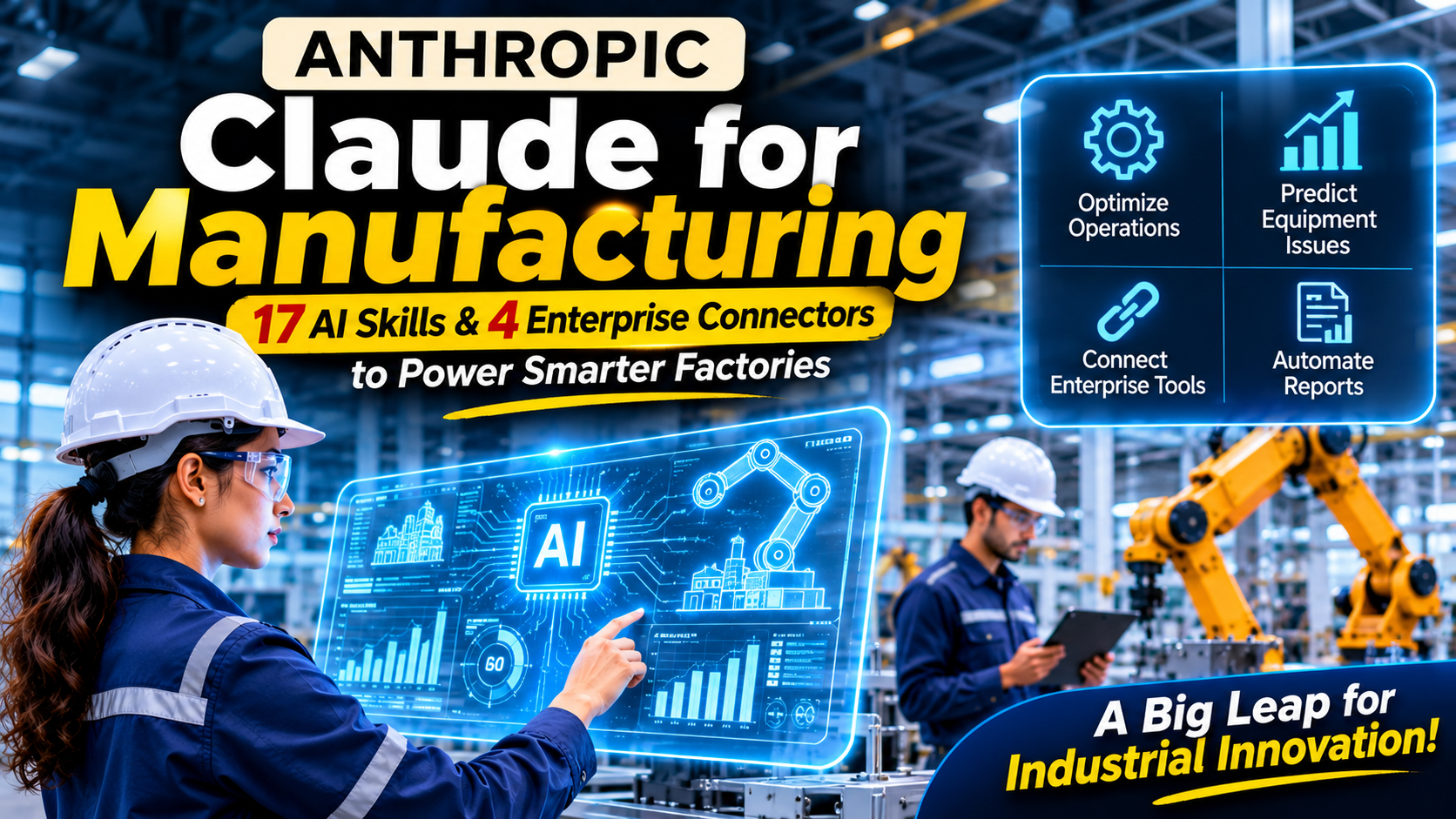
Anthropic Launches Claude for Manufacturing: 17 AI Skills Aim to Transform Factory Workflows
Artificial intelligence is moving beyond chatbots, content creation, and software development. It is increasingly entering specialized industries where businesses need help managing complex operations and large amounts of information.
On November 12, 2026, Anthropic announced Claude for Manufacturing, a new plugin designed to help manufacturing companies use AI in everyday industrial workflows. The solution includes 17 specialized AI skills and four connectors that allow Claude to work with information stored in commonly used manufacturing and enterprise software.
The announcement highlights a growing direction in enterprise AI: instead of simply answering questions, AI assistants are being developed to help employees complete multi-step business tasks using their organization's existing information.
1. What Is Claude for Manufacturing?
Claude for Manufacturing is a specialized plugin for Anthropic's Claude AI assistant. It is designed around the needs of manufacturing teams, including estimators, quality engineers, technicians, buyers, planners, and production managers.
Manufacturing work often involves collecting information from different systems, checking previous records, comparing costs, preparing reports, and communicating with suppliers. These activities can consume significant employee time.
Claude for Manufacturing aims to reduce this administrative workload by helping employees gather relevant information, analyze records, and prepare documents for review.
For example, an estimator can ask Claude to examine a customer's request, identify missing information, compare costs from similar past jobs, and prepare a draft quotation.
The employee remains responsible for checking and approving the final result.
2. Seventeen Specialized AI Skills
One of the major features of the announcement is the inclusion of 17 manufacturing-focused skills.
These skills cover six broad areas:
Sales
Quality
Operations
Supply chain
Design
Setup
Some skills perform individual tasks, while others combine multiple steps into a workflow. This allows Claude to assist with a process from information gathering to preparing a draft for human review.
Here are some examples described by Anthropic.
Quoting New Manufacturing Jobs
When a company receives a new customer request, Claude can examine the requirements, identify missing details, compare costs from similar previous jobs, and prepare a quotation draft.
This can help estimators spend less time searching through old records.
Investigating Quality Problems
When a product fails an inspection, Claude can help document the problem, search previous quality reports for similar cases, rank possible causes, and prepare a corrective-action report.
A quality engineer can then review the evidence and decide what action should be taken.
Diagnosing Machine Breakdowns
When a machine stops working, technicians may need to examine sensor exports, repair notes, photographs, and technical manuals.
Claude can review these materials and organize possible causes so that the technician knows what to investigate first.
It does not independently repair or operate the machine.
Managing Suppliers
The plugin can help purchasing teams prepare requests for quotations and compare supplier bids. It can also help buyers check purchase orders and stock information before making decisions.
Comparing Product Designs
Through its Autodesk Fusion connector, Claude can help engineers generate design variations, compare them against specified targets, and prepare decision documents.
Preparing Production Reports
Production managers can use Claude to compile information about output, targets, equipment downtime, and the estimated cost of missed production into a single report.
3. Four Enterprise Connectors
Claude for Manufacturing connects with four important enterprise systems:
Autodesk Fusion: Supports engineering and design workflows.
Infor: Helps teams look up purchasing, inventory, and planning records.
Microsoft 365: Provides access to relevant documents, shared folders, emails, and reports.
Oracle NetSuite: Helps estimators work with orders, inventory, production steps, and job costs.
These connectors allow Claude to work with information from systems manufacturers already use rather than requiring every task to begin with manually copied data.
Anthropic also explains that manufacturers can use exported files from systems that do not have a direct connector, provided those files are saved in a supported location such as Microsoft 365.
4. Human Approval Remains Important
A major point in Anthropic's announcement is that manufacturing employees remain responsible for important decisions.
Claude can prepare quotations, reports, supplier requests, and recommendations, but the responsible employee reviews and approves the work before it reaches a customer or supplier.
The system can also provide links back to the underlying records and documents used in its drafts. This helps employees check where information came from.
This is particularly important in manufacturing, where incorrect measurements, quotations, quality decisions, or supplier information can have financial and operational consequences.
Anthropic also makes clear that Claude for Manufacturing does not operate factory equipment or directly run production control systems.
5. Why This Matters for Indian Manufacturing
India has a large manufacturing ecosystem covering automobiles, pharmaceuticals, electronics, textiles, machinery, steel, and many other industries.
Factories in these sectors regularly handle technical documents, supplier records, quality reports, inventory information, and production data.
AI tools that help organize and analyze this information could be useful for companies seeking to improve productivity without immediately replacing their existing software systems.
For smaller manufacturers, the practical value will depend on factors such as software compatibility, data quality, implementation costs, employee training, and the availability of suitable paid AI plans.
The announcement does not establish how much money companies will save or how many factories have already adopted the plugin. Those results will need to be evaluated through real-world use.
6. Opportunities for Students and Developers
The launch also offers an interesting example for engineering and computer science students.
Students interested in Artificial Intelligence, Machine Learning, and software development can explore how AI can be applied to real industrial problems.
Some useful project ideas include:
AI-based product defect detection.
Predictive maintenance systems using sensor data.
Automated production-report generation.
Supplier comparison and recommendation tools.
AI assistants for searching technical manuals.
Inventory monitoring and demand forecasting.
These applications combine AI with practical engineering and business requirements.
7. Availability and What Comes Next
Anthropic says Claude for Manufacturing can be installed on Team or Enterprise plans. Organizations can configure the plugin with their manufacturing systems and test which skills are supported by their available connectors.
The company also plans to add more manufacturing skills over time.
For manufacturers, the next important question is how well these AI workflows perform with real factory data, existing software, and the safety and approval procedures already used by their teams.
Conclusion
Claude for Manufacturing represents another step toward industry-specific AI assistants. Its 17 skills and four enterprise connectors are designed to help employees handle tasks such as preparing quotations, investigating quality issues, diagnosing breakdowns, managing suppliers, and reporting production results.
The technology does not replace manufacturing experts or operate factory machinery. Instead, it aims to help employees gather information and prepare work more efficiently while keeping important decisions under human control.
As industrial AI develops, the combination of engineering knowledge, reliable company data, and AI-assisted workflows could become increasingly important for modern factories.
Source: Anthropic – Introducing Claude for Manufacturing.