Anthropic Expands AI Cybersecurity Access
Learn how Anthropic's Cyber Verification Program provides tiered access to advanced cybersecurity AI for defense,authorized testing,and specialized security work.
Source: https://www.anthropic.com/news/cyber-verification-program
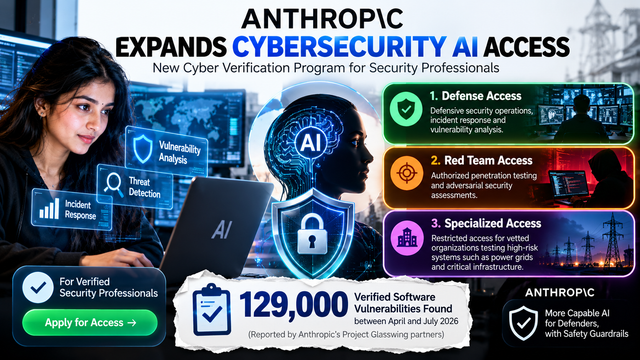
Anthropic Expands Cybersecurity AI Access: What the New Verification Program Means
Introduction: AI Is Becoming an Important Cybersecurity Tool
Cybersecurity teams face a constantly changing environment. New software vulnerabilities appear, attackers develop new techniques, and organizations must protect sensitive information across increasingly complex digital systems.
Artificial intelligence is becoming a useful tool in this environment. Depending on the system and its capabilities, AI can help security professionals review code, identify suspicious activity, investigate vulnerabilities, summarize incidents, and prioritize defensive work.
However, the same capabilities that help defenders can also be misused. A powerful AI system may assist legitimate security testing, but it could also be used by someone attempting to discover weaknesses in systems they do not own or have permission to test.
This creates an important challenge for AI companies: how can they provide useful cybersecurity capabilities to qualified professionals while reducing the risk of harmful use?
Anthropic's Cyber Verification Program is an attempt to address this challenge. According to the company's announcement dated October 6, 2026, Anthropic expanded the program to allow verified security professionals to apply for different levels of access to advanced cyber capabilities.
The initiative highlights a broader change in the AI industry. Instead of treating every user and every cybersecurity task identically, providers are exploring ways to consider the user's role, the intended activity, and the level of risk involved.
For security professionals, developers, businesses, and students, this development offers an opportunity to understand both the benefits and responsibilities associated with advanced AI security tools.
1. What Is Anthropic's Cyber Verification Program?
The Cyber Verification Program is designed to provide eligible cybersecurity professionals with access to advanced capabilities for legitimate security work.
Verification is important because cybersecurity tools can be used in very different circumstances. A professional testing an organization's systems with written authorization has a different purpose from someone attempting to break into a stranger's network.
The program introduces different access levels intended to reflect different kinds of security activity and risk.
Rather than assuming that every request for advanced capabilities is equally appropriate, this approach attempts to connect access with a professional purpose and suitable safeguards.
The three tiers described in the announcement are Defense Access, Red Team Access, and Specialized Access.
Each tier serves a different purpose, ranging from defensive security operations to authorized adversarial testing and carefully restricted work involving high-risk systems.
The exact capabilities available to an individual depend on the program's eligibility rules, verification requirements, and access conditions. Being a cybersecurity professional does not automatically guarantee approval for every tier.
2. Defense Access: Helping Security Teams Protect Systems
The first tier, Defense Access, is intended for defensive cybersecurity work.
Defensive security focuses on finding weaknesses, detecting suspicious activity, investigating incidents, and reducing the chance that an attacker can compromise a system.
For example, a security team might need to review a large amount of software code to determine whether it contains a vulnerability. Another team might investigate unusual login activity or examine alerts generated by its monitoring systems.
AI can potentially help with these tasks by organizing information, explaining code, identifying patterns, and suggesting areas that deserve further investigation.
Consider a company that maintains an application used by thousands of customers. Its security engineers must review updates, investigate reported weaknesses, and decide which problems need immediate attention.
An AI assistant could help engineers understand a suspicious code path or summarize the possible impact of a reported flaw. Human professionals would still need to validate the findings, test proposed fixes, and decide how to respond.
This distinction is essential. AI assistance can make security work more efficient, but an AI-generated finding is not automatically proof that a vulnerability exists.
Likewise, a suggested fix should be tested before being deployed into a production environment.
Defense Access reflects the potential value of advanced AI when its capabilities are directed toward protecting systems and improving security operations.
3. Red Team Access: Authorized Adversarial Testing
The second tier, Red Team Access, is intended for authorized penetration testing and adversarial security assessments.
A red team evaluates a system by testing it from the perspective of a potential attacker. The objective is to identify weaknesses that ordinary defensive checks might overlook.
Organizations use authorized security testing to understand how their systems could fail, whether their controls work as expected, and which improvements would reduce risk.
For example, a company might hire an approved security team to assess its web application, authentication process, or internal network. The team operates within an agreed scope and follows the organization's rules for testing.
Advanced AI could potentially help authorized testers understand unfamiliar code, organize observations, analyze findings, and document the results of an assessment.
But authorization remains fundamental.
A tool's ability to test a system does not give its user permission to test any system they choose. Responsible testing requires clear approval, a defined scope, and procedures for reporting and fixing vulnerabilities.
AI-generated suggestions also require professional judgment. A tester must determine whether a finding is real, whether a proposed test is within the agreed scope, and whether an action could disrupt a service or expose sensitive information.
Red Team Access therefore concerns legitimate adversarial security work, not unrestricted permission to attack systems.
4. Specialized Access: A More Restricted Level for High-Risk Work
The third tier, Specialized Access, is intended for vetted organizations working on high-risk systems, including critical infrastructure such as power grids.
Critical infrastructure supports essential services. Depending on the sector, it may include electricity networks, industrial control systems, communications infrastructure, water treatment facilities, and other systems whose disruption could affect many people.
Security testing in these environments requires particular care.
A mistake that causes a minor problem in a development environment could have much more serious consequences in an operational industrial system. Testing may need to account for safety requirements, operational schedules, backup procedures, and strict access controls.
For example, an organization assessing the security of an industrial control environment may need to work within a carefully approved testing plan. The team must understand which components can be tested, which actions are prohibited, and how to prevent an experiment from interfering with essential operations.
Specialized Access reflects the need for stricter evaluation when the potential consequences of misuse or error are especially significant.
It should not be interpreted as unrestricted access to critical infrastructure. The purpose of verification and access controls is to manage risk, and the details of each engagement matter.
This tier also demonstrates that cybersecurity is not simply a software problem. In high-risk environments, security decisions can affect public services, physical equipment, and human safety.
5. Why Does Verification Matter for Advanced AI?
Verification is one part of a broader approach to responsible AI deployment.
An organization offering powerful security capabilities needs to consider several questions:
Who is requesting access?
What legitimate activity will the tool support?
What systems will be involved?
What permissions does the user have?
What safeguards are appropriate for the task?
How should misuse or suspicious activity be handled?
Verification can help establish whether an applicant meets the program's requirements. Different access tiers can then distinguish between different intended uses and risk levels.
However, verification is not a guarantee that every action will be safe. A verified user can make mistakes, and credentials can be misused or compromised.
That is why access controls should be combined with clear rules, monitoring where appropriate, careful system design, and human accountability.
Organizations must also understand how sensitive information is handled. Security investigations can involve source code, system architecture, logs, and information about vulnerabilities that have not yet been fixed.
Protecting that information is an important part of responsible AI-assisted cybersecurity.
The wider lesson is that advanced AI capabilities should be deployed with attention to both usefulness and the potential consequences of misuse.
6. Project Glasswing and the Reported 129,000 Vulnerabilities
Anthropic's announcement also discussed Project Glasswing partners and their work identifying software vulnerabilities.
The company reported that participating partners had identified at least 129,000 verified software vulnerabilities between April and July 2026.
This is a striking figure, but it needs to be interpreted carefully.
The number is Anthropic's reported figure concerning Project Glasswing partners. It should not be presented as an independently established total for all software vulnerabilities discovered worldwide during that period.
Understanding what a vulnerability count represents also matters. A verified vulnerability is a weakness that has been assessed as real under the relevant verification process. Counts can depend on the participating organizations, software examined, definitions used, and procedures for identifying and validating findings.
A large number of findings does not, by itself, tell us how severe every vulnerability was, how many affected widely used products, or how many have already been fixed.
Nevertheless, the report illustrates why AI-assisted vulnerability discovery is attracting attention.
Modern software systems can contain millions of lines of code and depend on many libraries and services. Security teams need practical ways to identify weaknesses, assess their significance, and decide which issues to address first.
AI may help accelerate portions of this process, but the quality of the result depends on validation, context, and responsible remediation.
7. How AI Can Help Find Software Vulnerabilities
Software vulnerabilities can arise from many causes, including incorrect input handling, insecure permissions, authentication errors, unsafe assumptions, and mistakes in the way components interact.
Security engineers use several methods to discover these weaknesses. They may review source code, run automated tests, examine dependencies, inspect logs, and conduct authorized security assessments.
AI can potentially support this work in several ways.
Code understanding: AI can explain unfamiliar functions and help developers identify sections that deserve additional review.
Finding prioritization: A tool can help organize findings so engineers can investigate the most important issues first.
Security documentation: AI can assist with summaries of reported vulnerabilities, remediation plans, and technical explanations for different audiences.
Defensive analysis: When used with suitable tools and permissions, AI can help interpret security alerts and organize evidence during incident response.
Fix validation support: AI may suggest tests or review proposed patches, although the tests must still be run and the results checked.
These capabilities can be useful, but AI systems can also produce false positives, overlook important context, or suggest incorrect fixes.
Security professionals therefore need to validate findings against the actual software and operating environment.
A responsible workflow combines automated assistance with established testing practices, code review, controlled experiments, and human approval.
8. What Does This Mean for Cybersecurity in India?
India's digital economy includes financial services, software companies, e-commerce platforms, public services, telecommunications, and many other systems that depend on reliable technology.
Organizations in these sectors need to protect customer information, prevent unauthorized access, and maintain the availability of important services.
AI-assisted security tools could help qualified teams review code, investigate alerts, document incidents, and prioritize vulnerabilities.
For Indian businesses, the important question is not simply whether an advanced AI model is available. It is whether the organization has the expertise, permissions, and processes needed to use it responsibly.
Companies should establish clear rules for what information can be shared with AI services, how security findings are reviewed, and who approves changes to production systems.
Organizations handling sensitive information must also consider applicable legal, contractual, and regulatory requirements.
For students, this news highlights the importance of learning secure coding, networking, operating systems, vulnerability management, and ethical security testing alongside AI.
Understanding AI tools is valuable, but foundational cybersecurity knowledge remains essential. A student who understands how a web application works is better positioned to evaluate whether an AI-generated security finding is meaningful.
Indian startups may also find opportunities to develop defensive tools, secure software development workflows, and training resources for organizations that need stronger security practices.
These are potential opportunities rather than a guarantee that a particular Anthropic program or capability is available to every Indian applicant.
Interested professionals should check the official program's current eligibility, geographical availability, and terms before applying.
9. Opportunities for Cybersecurity Students and Developers
Students interested in cybersecurity can use this announcement as a reason to develop practical skills in a controlled environment.
A good starting point is a deliberately vulnerable training application or a personal project that the learner owns and is authorized to test.
Students can practise reviewing source code, writing tests, identifying insecure configurations, and documenting vulnerabilities responsibly.
AI can be used as a learning assistant to explain unfamiliar concepts or help organize a remediation plan, provided the student verifies the information independently.
Developers can also integrate security checks into their software development lifecycle. For example, a project might combine dependency scanning, code review, automated tests, and human approval before a release.
AI may help explain findings and reduce repetitive documentation work, but it should not replace the controls that prevent insecure code from reaching production.
For aspiring professionals, useful areas of study include secure software development, application security, incident response, cloud security, threat modeling, and responsible vulnerability disclosure.
The most valuable skill is not simply knowing how to ask an AI model a security question. It is understanding the system well enough to judge the answer.
10. Risks and Limitations of Advanced Cybersecurity AI
Advanced cybersecurity AI creates important opportunities, but it also introduces risks.
Potential misuse: Capabilities intended for security work could be used to support unauthorized activity if safeguards fail.
Incorrect findings: AI may report weaknesses that do not exist or miss vulnerabilities that require deeper contextual analysis.
Sensitive data exposure: Source code, credentials, logs, and vulnerability details can be confidential. Organizations need appropriate data-handling controls.
Overreliance on automation: Teams that accept AI output without review may introduce new security problems.
Operational disruption: Security testing can affect production systems if the scope and safeguards are not carefully managed.
Unequal access: Verification requirements and program restrictions may mean that not every interested researcher can obtain the same capabilities.
Changing threat conditions: Attackers and defenders continually adapt, so safeguards and security processes require ongoing review.
These limitations explain why access controls, professional standards, and human oversight remain important even as AI becomes more capable.
A verification program can help manage access, but it cannot eliminate every security risk. Organizations must continue to use layered defenses and established incident-response practices.
11. What Businesses Should Do Next
Businesses interested in AI-assisted cybersecurity can take several practical steps.
First, identify a clearly defined defensive use case. Examples include helping developers understand code-review findings or summarizing alerts for an incident-response team.
Second, determine what information the AI system will receive and whether that information is appropriate to share with the service.
Third, establish permissions and approval requirements. AI should not automatically receive unrestricted authority over production systems or sensitive infrastructure.
Fourth, test the workflow in a controlled environment. Compare AI-generated findings with established tools and expert review.
Fifth, measure results. Relevant metrics might include the time required to investigate an issue, the proportion of findings confirmed by analysts, and the time taken to remediate verified vulnerabilities.
Finally, keep humans accountable for important decisions. A security tool should support the team rather than obscure who approved an action or why a change was made.
These principles apply whether a business uses Anthropic products, another AI provider, or conventional security automation.
Conclusion: Powerful AI Needs Responsible Access
Anthropic's expanded Cyber Verification Program highlights a central challenge in modern artificial intelligence: capabilities that can improve cybersecurity may also create risks when used without appropriate authorization.
The program's three tiers distinguish defensive security operations, authorized red-team assessments, and more restricted work involving high-risk systems.
Anthropic's reported Project Glasswing figure of at least 129,000 verified software vulnerabilities between April and July 2026 also illustrates the growing interest in AI-assisted vulnerability discovery. That figure remains a company-reported result involving participating partners, not a universal industry-wide count.
For cybersecurity professionals, the message is that AI may help accelerate parts of security work, but verified findings, careful testing, and responsible remediation remain essential.
For Indian students and businesses, this is a useful reminder to build strong foundations in secure software development and ethical security practices before relying on advanced automation.
The future of cybersecurity will not depend only on how powerful AI becomes. It will also depend on how carefully those capabilities are accessed, evaluated, and used to protect real systems.
Official source: Anthropic — Cyber Verification Program.