Anthropic Certifies 85,000 Claude Professionals
Anthropic says 85,000 people are now certified to work with Claude, signaling a fast-growing market for AI implementation skills.
By singamankitha
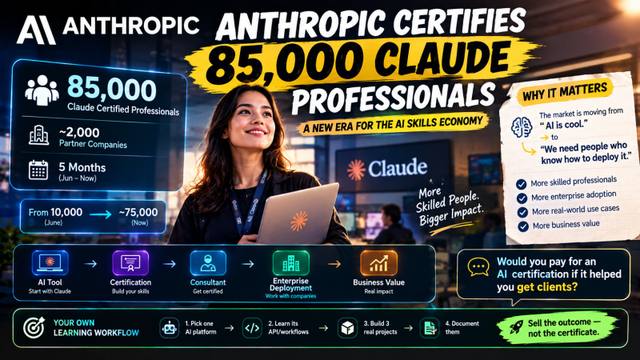
Anthropic Certifies 85,000 Claude Professionals — The AI Skills Economy Is Taking Shape
The AI industry is entering a new phase.
It is no longer just about who can use the latest AI model.
It is increasingly about who knows how to deploy AI inside real businesses.
Anthropic says roughly 85,000 people have received Claude-related certifications, spanning nearly 2,000 partner companies over a five-month period.
The growth is notable because it points toward something bigger than another AI product milestone: the emergence of an AI implementation and consulting economy.
From “AI Is Cool” to “We Need AI Experts”
For the past few years, the conversation around artificial intelligence has largely focused on models.
Which model is smartest?
Which chatbot writes better?
Which AI generates better images?
But enterprises have a different question:
“Who can actually make this technology useful for our business?”
That changes the value of AI skills.
Knowing that Claude exists is easy.
Knowing how to integrate it into a company's workflows, automate repetitive tasks, connect it to internal tools, build reliable processes, and measure business results is much more valuable.
The Certification Pipeline
The emerging pathway looks something like this:
AI platform
↓
Training & certification
↓
Skilled professional
↓
Consulting / implementation
↓
Enterprise deployment
↓
Business value
That is the important signal behind Anthropic's reported certification numbers.
The opportunity may not simply be in becoming an “AI user.”
It may be in becoming the person who helps organizations use AI effectively.
Why Businesses Need AI Implementation Skills
Companies experimenting with AI often run into the same problems.
They may have access to powerful models but struggle with:
Building repeatable AI workflows
Connecting AI to existing software
Automating internal processes
Creating reliable prompts and systems
Evaluating AI outputs
Managing AI costs
Training employees
Deploying AI safely
Measuring return on investment
That creates room for a new type of professional.
Not necessarily a traditional software engineer.
Not necessarily a traditional consultant.
But someone who understands AI + workflows + business problems.
The Certificate Is Not the Product
There is an important distinction here.
A certification can demonstrate that someone has learned a platform.
But businesses ultimately pay for outcomes.
A company does not necessarily want someone who can say:
“I am certified in Claude.”
It wants someone who can say:
“I can reduce this workflow from four hours to thirty minutes.”
Or:
“I can build an internal research assistant for your team.”
Or:
“I can automate your customer-support knowledge workflow.”
That is where AI skills become commercially useful.
A Practical Path to Building AI Skills
If you want to turn AI knowledge into something valuable, you don't necessarily need to collect dozens of certificates.
Start with one major AI platform.
Step 1 — Learn One Platform Deeply
Understand its:
Models
Prompting
APIs
Tool use
Context handling
Workflows
Integrations
Limitations
Depth can be more useful than constantly jumping between platforms.
Step 2 — Build Three Real Projects
Don't stop at tutorials.
Build projects that solve actual problems.
For example:
Project 1: An AI research assistant
Project 2: An automated business-content workflow
Project 3: An AI customer-support or knowledge assistant
The goal is to demonstrate what you can actually build.
Step 3 — Document Everything
Turn each project into a mini case study.
Show:
Problem → Solution → Workflow → Result
This gives potential clients something much more tangible than a certificate alone.
Step 4 — Sell the Outcome
Instead of saying:
“I know Claude.”
Position the skill around the business result:
“I build AI workflows that reduce repetitive research and documentation work.”
That shift can completely change how clients perceive the value of your expertise.
The Bigger AI Career Shift
AI is creating a new layer between AI companies and traditional businesses.
Model companies build the technology.
Businesses want to use it.
And professionals can help connect the two.
That creates potential opportunities for:
AI consultants
Automation specialists
AI workflow designers
AI trainers
AI implementation specialists
AI solution architects
Prompt and workflow engineers
AI-focused agencies
AI educators
The exact job titles may change.
The underlying skill is the same:
Turn AI capabilities into useful business systems.
Why This Matters for Students and Creators
This trend is particularly interesting for people learning AI today.
You don't necessarily need to become an AI researcher to participate in the AI economy.
You can specialize in implementation.
Learn a platform.
Understand APIs and workflows.
Build useful systems.
Create case studies.
Then help other people or businesses deploy those systems.
The competitive advantage isn't simply knowing how to open an AI chatbot.
It is knowing what to build with it.
The Certification Economy Is Just Beginning
Anthropic's reported certification numbers are a sign that AI education is becoming increasingly connected to professional services.
As more businesses adopt AI, they will need people who can bridge the gap between:
Powerful models
and
practical business applications.
That gap is where a large part of the next AI-skills economy could develop.
And the most valuable AI professionals may not be the people who know every model.
They may be the people who can take one powerful AI platform and turn it into measurable business value.
The Bottom Line
AI adoption is moving beyond experimentation.
The next question for companies is increasingly:
“Who can actually deploy this?”
Anthropic's reported 85,000 Claude certifications show how quickly an ecosystem of trained professionals can form around a major AI platform.
For individuals, the lesson is simple:
Don't just learn AI. Build with it. Document what you build. Then learn how to turn those skills into outcomes.
The certificate can open the conversation.
The results close the deal.