Andrew Tulloch Leaves Meta to Join Anthropic portrait
The prominent AI researcher joins Anthropic's performance team as leading labs compete for top AI talent.
By @admin
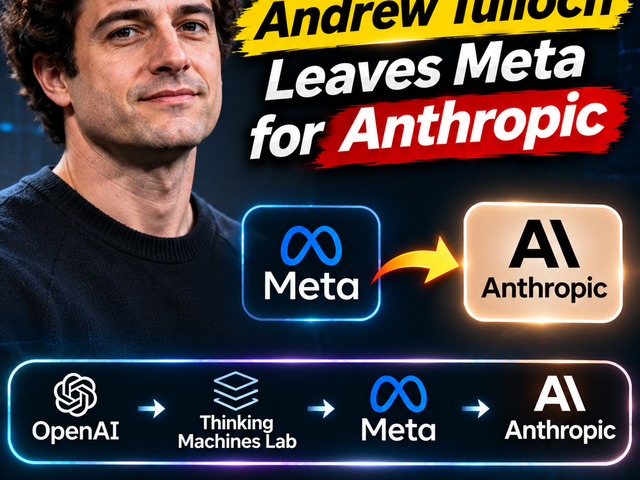
Andrew Tulloch Leaves Meta for Anthropic: The AI Talent War Is Getting More Intense
The competition between the world's leading artificial intelligence companies is no longer just about who can build the biggest AI model. It is also about who can attract the researchers capable of making those models faster, more efficient and more powerful.
A recent move involving prominent AI researcher Andrew Tulloch has brought that competition back into focus.
Tulloch is leaving Meta to join Anthropic, the company behind Claude. He is expected to work on Anthropic's inference and performance team, focusing on model training and improving how efficiently AI systems respond to users.
The move is significant because Tulloch has worked across several major AI organizations, including Meta, OpenAI and Thinking Machines Lab. His career reflects how a small group of highly experienced researchers has become extremely valuable to the companies competing to develop frontier AI.
1. Who is Andrew Tulloch?
Andrew Tulloch is an AI researcher and engineer known for his work on large-scale machine learning systems and model training.
Unlike technology executives who are regularly in the public spotlight, researchers such as Tulloch tend to work behind the scenes. Their contributions can nevertheless influence how AI models are trained, how much computing power they require and how efficiently they operate.
Tulloch spent approximately 11 years at Meta, formerly Facebook, before leaving in 2023 to join OpenAI.
At OpenAI, he contributed to the development and training of major models, including GPT-4o, GPT-4.5 and o3, according to reporting about his career.
He later co-founded Thinking Machines Lab in 2025 with former OpenAI chief technology officer Mira Murati and other researchers.
After that, he returned to Meta in 2025 as part of the company's aggressive effort to recruit experienced AI talent.
Now, in September 2026, he is moving to Anthropic.
This sequence is important because it shows that the competition for AI researchers involves movement between established technology giants and ambitious startups.
2. Why is he joining Anthropic?
According to Business Insider's reporting, Tulloch is joining Anthropic's inference and performance team.
The team focuses on improving the performance of AI models, including how they are trained and how they respond to users.
This is a strategically important area.
Building a powerful AI model is only one part of the challenge. Companies also need to make that model practical to operate at scale.
When millions of people use an AI assistant, every response requires computing resources. The speed, efficiency and cost of generating those responses can have a major effect on the company's infrastructure expenses and customer experience.
Anthropic competes with OpenAI, Google, Meta and other AI developers. Improving the efficiency of its models can help it deliver better performance while managing the cost of serving users.
Tulloch's background in large-scale training and AI engineering is relevant to that challenge.
However, his hiring should not be interpreted as proof that Anthropic has already achieved a specific performance improvement. The impact of the appointment will depend on the work completed by the team over time.
3. His career journey: Meta to OpenAI to Thinking Machines and back
Tulloch's career is especially interesting because it connects several important organizations in the AI industry.
Stage 1 — Meta
He spent around 11 years at Meta, working on large-scale machine learning systems. This gave him experience with the infrastructure and engineering challenges involved in operating machine learning at scale.
Stage 2 — OpenAI
In 2023, he moved to OpenAI. His work included contributing to the training of models such as GPT-4o, GPT-4.5 and o3.
These models represent different stages of OpenAI's development of advanced general-purpose and reasoning capabilities.
Stage 3 — Thinking Machines Lab
In 2025, Tulloch co-founded Thinking Machines Lab with Mira Murati and other former AI researchers.
The company attracted significant attention because of its experienced founding team and ambitions in advanced AI research.
Stage 4 — Return to Meta
Tulloch later returned to Meta in 2025. His recruitment became part of the broader competition for experienced AI researchers.
Stage 5 — Anthropic
In September 2026, he moved to Anthropic to work on inference and performance.
This journey illustrates how quickly senior AI talent can move between competing organizations.
4. What is inference, and why is it so important?
To understand why Anthropic is interested in inference performance, it helps to understand two important stages of AI development: training and inference.
Training is the process through which an AI model learns patterns from large amounts of data and adjusts its internal parameters.
It requires substantial computing resources and can take a long time.
Inference happens when a trained model is used to generate an answer or perform a task.
For example, when someone asks ChatGPT or Claude a question, the system processes the request and generates a response. That process is inference.
Why does inference matter so much?
Imagine an AI company serving millions of users every day.
If each response takes too long or consumes too much computing power, the company faces higher costs and a worse user experience.
Improving inference can help with:
- Faster response times.
- Lower computing costs per response.
- Better use of available hardware.
- More efficient deployment of large models.
- Greater capacity to serve users.
This is why inference optimization has become a major area of competition.
A company does not necessarily need to build a dramatically larger model to improve its product. It can also improve how efficiently its existing models operate.
5. The reported $1.5 billion Meta compensation package
One detail that attracted significant attention during Tulloch's earlier recruitment by Meta was a reported compensation package that could potentially reach $1.5 billion over six years.
This figure became a symbol of how aggressively technology companies were competing for elite AI talent.
But there is an important distinction.
The reported figure represented a potential maximum based on compensation components and conditions. It was not confirmed money paid to Tulloch.
Meta publicly disputed the characterization of the reported package, and the actual terms of his compensation were not disclosed.
It would therefore be inaccurate to say that Tulloch received $1.5 billion or took that amount with him to Anthropic.
The broader point remains: major AI companies are willing to compete intensely for researchers with rare expertise.
6. Why are AI researchers becoming so valuable?
The AI industry has entered a stage where technical talent can influence a company's competitive position.
A highly experienced researcher may understand problems that are difficult to solve through simply increasing a company's budget.
These include:
Model training: How to train advanced models effectively using large computing clusters.
Inference optimization: How to generate responses faster and with fewer computing resources.
Systems engineering: How to coordinate hardware, software and distributed computing infrastructure.
Model performance: How to improve reliability, reasoning and usefulness.
Scaling: How to develop systems that can handle increasing workloads and more demanding tasks.
These skills are not easy to replace.
Companies can purchase additional GPUs and build new data centres, but experienced researchers who understand how to use that infrastructure effectively are much harder to recruit.
That is one reason why the competition for AI talent has become so intense.
7. Meta, OpenAI, Anthropic and Google: The bigger talent war
Tulloch's move is part of a wider pattern of researchers changing organizations.
Meta has invested heavily in recruiting experienced AI researchers and building its AI research capabilities.
OpenAI continues to compete in frontier model development while expanding its products and infrastructure.
Anthropic is investing in Claude and the systems required to train and serve its models efficiently.
Google has deep expertise in AI research, custom computing hardware and large-scale infrastructure.
Startups such as Thinking Machines Lab also compete for experienced researchers by offering the opportunity to work on new approaches without the organizational structure of a large technology company.
This movement of researchers matters because knowledge travels with people.
When an experienced researcher changes organizations, they bring technical experience, engineering judgement and an understanding of difficult problems. They do not transfer their former employer's confidential information or intellectual property simply by changing jobs.
The movement of talent can nevertheless influence which organizations have the expertise needed to make progress.
8. What does this mean for the future of AI?
The next phase of AI competition may depend on more than model size.
Companies will need to improve several areas simultaneously:
- Better model capabilities.
- Faster inference.
- Lower operating costs.
- More efficient training.
- Reliable AI products.
- Stronger infrastructure.
For everyday users, these improvements could eventually translate into AI assistants that respond faster, handle more complex tasks and cost less to operate.
For developers and businesses, more efficient AI systems could make it easier to integrate advanced models into applications, customer support systems and business workflows.
For India, this trend is particularly relevant to the growing AI startup ecosystem. Companies building AI products need to think not only about model capabilities but also about deployment costs, latency and infrastructure efficiency.
9. The real takeaway: The AI race is also a people race
Andrew Tulloch's move from Meta to Anthropic is more than an ordinary job change.
It highlights the strategic importance of experienced researchers in an industry where technical improvements can create significant competitive advantages.
The companies competing in AI need computing power, data, infrastructure, customers and capital. But they also need people who know how to turn those resources into better models and products.
That is why the movement of a relatively small number of researchers attracts so much attention.
The next major AI breakthrough may come from a new model architecture, a better training technique or a more efficient inference system. Behind those developments will be teams of people solving difficult engineering and research problems.
The AI talent war is not just about who can pay the most. It is about who can build the strongest team to shape the next generation of artificial intelligence.