Amazon AI: Data Race for Training
A 404 Media investigation tracked rare books to an Amazon facility where books are reportedly scanned for AI-related data and destroyed.
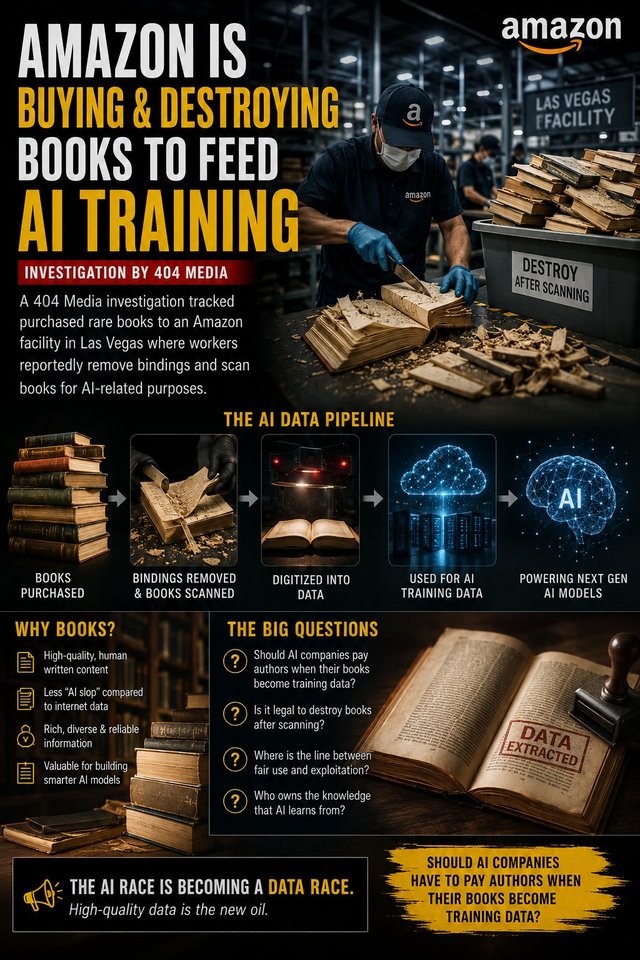
Amazon Books and AI Training: The New Data Race
The AI race has usually been described in terms of chips, data centers, and increasingly powerful models.
But there is another resource that may become just as important:
high-quality human-created data.
A recent investigation by 404 Media has brought that issue into focus by reporting that physical books purchased through Amazon were tracked to a facility in Las Vegas where workers reportedly removed their bindings and scanned the books. The investigation connected the operation to efforts involving AI-related data. Amazon confirmed that it purchases books through commercial channels to help develop and improve products and services.
That sounds like a strange process in the age of digital information.
Why would an AI company—or a company working around AI—need physical books when billions of pages are already available online?
The answer is surprisingly important.
Not all data is equal.
Why AI companies want books
Large AI models need enormous amounts of information during development.
The internet is an obvious source.
Web pages contain news, discussions, documentation, technical information, educational material, opinions, and countless other forms of human knowledge.
But the open web has a problem.
It is increasingly filled with AI-generated content.
As generative AI becomes widespread, more websites are publishing automatically generated articles, summaries, product descriptions, images, and other material.
That creates a strange feedback loop.
AI systems generate content.
That content gets published online.
Future AI systems may encounter that content while collecting data.
The boundary between human-created information and machine-generated information becomes harder to determine.
Books offer something different.
They are generally edited, structured, and created through a much more deliberate publishing process.
A professionally published book can contain hundreds of pages of concentrated human knowledge.
That makes books potentially valuable as training material.
404 Media reported in July that ISBNdb, a company offering book-acquisition services for AI-related training data, described books as curated and authoritative sources that differ from ordinary web crawls.
So while the idea of buying physical books to obtain data might sound inefficient, there is a logic behind it.
Why physically scan a book?
If a company needs the text inside a physical book, it has to convert that physical information into digital data.
That means scanning.
The process can involve removing the binding, separating pages, scanning the pages, and using optical character recognition—or OCR—to convert the images into machine-readable text.
Once digitized, the text can potentially be processed, indexed, analyzed, or used in other data workflows.
The physical book itself is no longer the important part.
The information inside it is.
And that's where the controversial part begins.
If a physical book is purchased, disassembled, scanned, and then discarded, the company has effectively transformed a physical copyrighted work into a digital dataset.
That raises difficult questions about ownership, licensing, copyright, and compensation.
Amazon's role needs to be described carefully
This story has generated a lot of dramatic headlines.
But there is an important distinction between what the investigation established and what people might assume from the headline.
The investigation does not establish that Amazon is buying every book it can find and secretly feeding all of them into a specific AI model.
It also does not establish that every book purchased through Amazon is being used for AI training.
Amazon's position, as reported in connection with the investigation, is that it purchases books through commercial channels to help develop and improve products and services.
That is a much narrower claim.
So the accurate story isn't:
"Amazon is secretly destroying books to train its AI."
The more defensible version is:
An investigation tracked purchased books to an Amazon facility where they were reportedly scanned, highlighting how physical books are becoming valuable sources of AI-related data.
That distinction matters.
Especially when the topic involves copyright and major technology companies.
The real bottleneck could be data
AI development is often discussed as a hardware race.
Companies need enormous numbers of GPUs.
They need data centers.
They need electricity.
They need cooling.
They need networking infrastructure.
All of that matters.
But models also need data.
And as AI systems improve, simply collecting more random internet content may not be enough.
Companies increasingly need high-quality, diverse, reliable human-generated information.
That's where books become interesting.
A good book isn't just a collection of words.
It can contain years of research, carefully organized explanations, examples, arguments, historical information, technical knowledge, creative writing, and human perspectives.
For an AI system attempting to learn about the world, that concentration of information can be extremely valuable.
The AI data race is changing
The first generation of large language models relied heavily on massive internet-scale datasets.
The next stage could involve increasingly specialized sources.
Books.
Scientific papers.
Technical documentation.
Licensed databases.
Human feedback.
Proprietary datasets.
High-quality educational material.
And potentially data that companies acquire directly rather than simply crawling from the public web.
This could turn data acquisition into a much more competitive industry.
The AI race may therefore become:
Compute + models + data.
And the data component could become increasingly expensive.
But what about copyright?
This is the elephant in the room.
Books are copyrighted works.
Authors spend months or years creating them.
Publishers invest in editing, production, marketing, and distribution.
So if those books are converted into training data for AI systems, an obvious question follows:
Should the creators be paid?
There is no simple global answer.
Copyright law differs between countries.
There are ongoing legal disputes about whether certain uses of copyrighted works for AI training qualify as fair use or other legal exceptions.
There are also licensing agreements in which AI companies pay publishers or other rights holders for access to content.
And then there is a separate philosophical question:
Even if something is legally permitted, is it fair?
Those are not necessarily the same question.
The author compensation debate
Imagine an author spends two years writing a 400-page book.
The book is professionally edited.
Readers buy it.
Years later, a company purchases a physical copy, scans the text, and processes the information as part of a large AI dataset.
What should happen?
One argument says the company bought the book legitimately, so processing its contents may be permitted depending on applicable law and circumstances.
Another argument says the economic value of the book is being extracted for a completely different commercial purpose and that the author should receive compensation.
A third possibility is licensing.
The AI company pays rights holders for permission to use the material.
This debate is likely to become increasingly important as AI companies seek higher-quality training data.
Why books are different from random web pages
There is another reason books are attracting attention.
The web is becoming noisy.
Search engines are filled with content designed to attract clicks.
Social platforms contain short-form posts.
AI-generated material is increasingly common.
Some websites publish content without strong editorial oversight.
Books are different because the publishing process can impose quality controls.
That doesn't mean every book is accurate.
It certainly doesn't mean books are free from bias or misinformation.
But books generally represent a much more concentrated form of human-created information.
For AI developers, that can be valuable.
The "AI slop" problem
There's an ironic problem emerging.
AI companies want more data to build better AI.
But AI is also producing huge amounts of new content.
Some of that content is low quality.
If future AI systems learn heavily from machine-generated material, researchers worry about the possibility of degrading training data quality.
This is one reason human-created sources can become more valuable.
The more synthetic content fills the internet, the more valuable genuinely human-created information may become.
In other words:
AI could make human data more valuable by creating too much artificial data.
That's a strange consequence of the AI boom.
Why physically destroying books sounds so shocking
There's also a cultural reason this story has generated such a strong reaction.
Books are physical objects.
People associate them with libraries, knowledge, education, history, and preservation.
Seeing a book cut apart and discarded after its information has been extracted feels fundamentally different from downloading a digital file.
It creates a powerful visual:
Physical knowledge → scanned → digitized → book discarded.
That image is likely to remain part of the public conversation around AI training.
But the emotional reaction shouldn't replace the factual question.
The important issue isn't simply whether the physical book survives.
It's what rights exist over the information contained inside it and how that information can legally and ethically be used.
The physical book may be disposable—but the data isn't
This is the central paradox.
From a data-processing perspective, the physical book might be nothing more than a container.
Once its contents have been digitized, the company doesn't necessarily need the physical object anymore.
But from an author's perspective, the book is the result of creative labor.
That creates a conflict between two ways of looking at the same object.
Data perspective:
The book is a source of information.
Creator perspective:
The book is copyrighted creative work.
Consumer perspective:
The book is something purchased to read.
AI industry perspective:
The book may be valuable training material.
These perspectives don't automatically agree.
What happens to AI training if high-quality data becomes scarce?
This could become one of the biggest questions in AI.
For years, the strategy was essentially:
Get more data. Build bigger datasets. Train bigger models.
But there may be limits.
There are only so many high-quality books.
Only so many scientific papers.
Only so much expertly written technical information.
And once a large portion of high-quality public data has already been processed, companies may have to compete for new sources.
That could create a data economy around content that was previously treated simply as information.
Authors, publishers, researchers, educators, and specialized communities could become increasingly important data suppliers.
Could licensing become the solution?
One potential answer is licensing.
Instead of acquiring books quietly or relying on uncertain legal interpretations, AI companies could negotiate agreements with publishers and rights holders.
The company gets access.
The creator gets compensated.
Everyone understands the terms.
That sounds straightforward.
In practice, it can become extremely complicated.
Who owns the rights?
Does the author or publisher have authority to license the work for AI training?
How much should the creator receive?
Should payment be based on the number of books?
The amount of text?
The size of the AI model?
The commercial value generated?
Should authors be able to opt out?
Should they be able to opt in?
Should AI companies disclose exactly which books were used?
These questions are still being debated.
Transparency may become just as important as payment
Suppose an author discovers that their book was included in an AI training dataset.
They may want to know:
Was it actually used?
Who obtained it?
When was it processed?
What model or system used it?
Was it licensed?
Was compensation provided?
Can the data be removed?
Without transparency, creators have little ability to understand what happened to their work.
That's why the AI training-data debate isn't only about money.
It is also about consent and visibility.
The bigger AI lesson
This story shows that the AI industry isn't only competing for computing power.
It is competing for information.
The best chips help models run.
The best algorithms help models learn.
But the quality of the underlying data can influence what those models ultimately know and how useful they become.
That's why books are becoming interesting again.
Not simply as physical objects.
As concentrated collections of human knowledge.
And that could make them one of the most valuable resources in the next stage of AI development.
So, is Amazon "destroying books to train AI"?
The honest answer is more complicated than the viral headline.
An investigation reported that purchased books were taken to an Amazon facility where they were reportedly processed and scanned for AI-related purposes.
Amazon confirmed that it purchases books commercially to develop and improve products and services.
But the available evidence does not establish that every book purchased by Amazon is being used to train a particular AI model.
That distinction should stay in the story.
Because the bigger issue is already interesting enough without exaggeration.
AI companies need high-quality data.
Books contain huge amounts of high-quality human-created information.
And obtaining that information raises difficult questions about copyright, compensation, consent, and the future economics of knowledge.
The new AI race
The next major AI competition may not simply be about who has the biggest model.
It could be about who has access to the best data.
Who can legally acquire it.
Who can license it.
Who can preserve it.
Who can process it.
And who can turn human knowledge into better AI systems.
That means the AI data race is becoming much more than a technical problem.
It's becoming an economic and cultural one.
And perhaps the most important question isn't:
"How much data can AI companies collect?"
It's:
"Who owns the knowledge that AI learns from—and who should benefit when that knowledge becomes part of the AI economy?"
That debate is only beginning.