Claude vs Amazon AI: Who Owns Creator Content?
Twitch now lets creators opt out of Amazon generative-AI training, but the setting is enabled by default, sparking a major creator-rights debate.
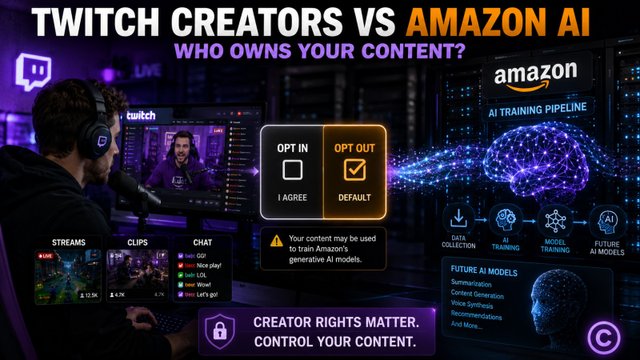
Twitch Creators Are Fighting Amazon Over AI Training
Twitch has become the latest battleground in the growing debate over creator content and AI training.
Amazon-owned Twitch now gives creators a setting that allows them to opt out of having their channel content used to train Amazon's generative-AI models.
The controversial part?
The setting is enabled by default.
That means creators who don't want their content included need to manually opt out.
According to reporting on Twitch's policy, the training-related setting can cover content such as:
Streams
Clips
Chats
Channel materials
However, there is an important distinction.
Turning off the generative-AI training option does not mean Twitch and Amazon stop using the content for every AI-related purpose. Other uses covered by Twitch's privacy policies, including AI-supported features such as recommendations, moderation and streamer-support tools, can still apply.
And that's where the controversy begins.
Opt-In vs Opt-Out
There are two very different approaches.
Opt-In
Creator → Explicitly agrees → Content can be used
The platform asks for permission first.
Opt-Out
Creator → Included by default → Must manually disable it
Critics argue that the second approach puts the responsibility on creators to discover the setting and change it themselves.
Twitch's Chief Product Officer Mike Minton reportedly defended the opt-out approach by saying an opt-in system would likely receive very little participation.
That statement has become one of the most controversial parts of the story because it raises a bigger question:
If creators are unlikely to agree voluntarily, should the default really be automatic participation?
Why This Matters Beyond Twitch
This isn't only about livestreamers.
The same debate could affect creators across the internet.
Think about everything a creator produces:
Video
↓
Voice
↓
Images
↓
Writing
↓
Captions
↓
Comments
↓
Audience interactions
All of this can potentially become valuable data in the AI economy.
The creator economy traditionally works like:
Creator → Content → Audience → Revenue
AI introduces another possible pathway:
Creator → Platform → Content/Data → AI Training → AI Product
That creates questions about consent, licensing, compensation, attribution and control.
The Real Creator-Rights Question
The debate isn't simply:
"Should AI exist?"
It's:
"Who gets to decide whether my work becomes part of an AI training dataset?"
And if that content helps create commercially valuable AI systems, another question follows:
"Should creators receive compensation?"
There is no universal answer yet.
Some creators may be comfortable allowing their content to train AI.
Others may want to license it separately.
Others may want to completely prohibit it.
The important issue is whether creators have clear information and meaningful control over that choice.
What Creators Should Do
If you use Twitch, check your account's Security & Privacy settings and review the Training for Generative AI option.
Don't assume that opting out of generative-AI training means all AI-related processing stops. Twitch's other AI-supported features can still be covered separately.
More broadly, creators should start paying attention to:
Platform AI policies
Training-data permissions
Licensing terms
Opt-in/opt-out settings
Commercial use of content
AI-related changes to terms of service
Because AI platforms are increasingly interested in the enormous amount of human-created content available online.
The Bigger Picture
Twitch is only one example of a much larger shift.
For years, creators fought over questions like:
Who owns my content?
Now another question is becoming just as important:
Who gets to use my content to build AI?
That could become one of the biggest creator-rights debates of the AI era.
The future may not simply be about protecting content from copying.
It may be about giving creators control over how their content becomes part of the AI economy.