AI Coding Agents Create a New Open-Source License Risk
SCANOSS has launched Earnie, a tool that checks AI-generated and reused code for open-source license obligations before it reaches production.
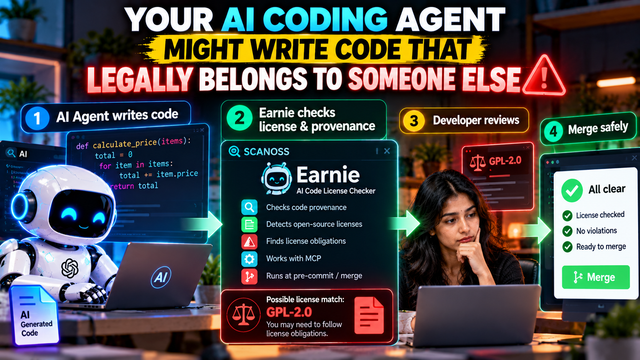
🤖 AI coding agents are creating a new open-source license problem
AI coding agents are changing how software is written. Developers can now ask an AI agent to build features, fix bugs, refactor code and work across an entire repository. But this speed introduces another challenge: where did the generated code actually come from, and does it carry open-source license obligations?
SCANOSS has launched Earnie, a software-governance tool designed to help developers identify these issues as AI-generated and reused code enters a project.
The problem is different from traditional dependency management. A normal software project might have an obvious dependency listed in package.json, requirements.txt or another package manifest. An AI coding agent, however, can introduce a small code fragment directly into a source file without adding an obvious dependency.
That means a traditional dependency scan may not always tell the complete story.
Earnie is designed to check code down to individual snippets, identify open-source components and map them to applicable license obligations. SCANOSS says the system can analyze developer code, copied or vendored code and code introduced by AI agents using the same detection approach. EIN Presswire
The workflow looks like this:
AI agent writes code → Earnie checks provenance and license → developer reviews → code is merged
One of the interesting parts is its integration with the Model Context Protocol (MCP). A coding agent can query Earnie during development to determine whether a component is allowed under a project's policy before adding it. Earnie can also run through CLI and pre-commit workflows, with checks continuing at pull requests and merge stages. EIN Presswire
This changes where license compliance happens.
Instead of:
AI writes everything → developer finishes → compliance team checks later
the goal becomes:
AI writes → compliance check happens during the workflow → developer resolves the issue → merge
SCANOSS says Earnie can identify applicable licenses and obligations, generate attribution and notice files, and maintain software bill of materials information using standards including CycloneDX and SPDX. EIN Presswire
The company also says its underlying knowledge base covers more than 188 million open-source components and 3 trillion lines of fingerprinted code across 12 programming languages. These figures are company-provided claims. EIN Presswire
The bigger issue is not that AI-generated code is automatically illegal or automatically copied from a particular project. The important point is that developers cannot assume AI-generated code has no licensing obligations simply because an AI wrote it.
For Indian startups and development teams increasingly using Claude Code, Copilot and other coding agents, this makes software provenance and license checking an increasingly important part of the AI development workflow.
The new development pattern could therefore look like:
AI coding agent → license/provenance check → human review → secure merge
AI is making coding faster. Tools like Earnie are trying to make sure compliance can keep up with that speed.