AI Agent Testing: AI Agents Are Getting AI Testers
AI agents are getting AI testers. TestMu AI can generate test scenarios, evaluate AI agents, run browser tests with Kane CLI, and help gate deployments.
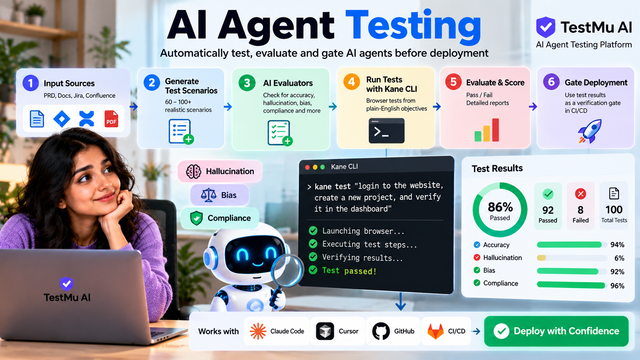
AI agents are becoming more powerful, but a new problem is becoming impossible to ignore: how do you know an AI agent actually works correctly before you let it ship?
TestMu AI is pushing AI agent testing toward a new product category. Its AI Agent Testing capabilities can generate large numbers of test scenarios from existing development material such as PRDs, documentation, Jira tickets and Confluence content. These scenarios can then be evaluated against important quality signals including hallucination, bias, compliance, accuracy and conversation behavior.
The idea represents a major change in how AI-powered software can be developed.
The old workflow was simple: build an AI agent, test a few important flows, and then ship it.
The emerging workflow looks more like:
Build → Automatically test → Attack edge cases → Score → Verify → Deploy
TestMu AI's Kane CLI adds another important layer to this workflow. Developers can describe browser objectives in plain English, and Kane CLI can execute those objectives against a real browser. It produces structured results and exit codes that can be used by CI/CD pipelines as a verification gate.
This becomes particularly interesting for AI coding agents such as Claude Code, Cursor and other developer agents. Instead of an AI agent writing code and simply assuming that the implementation works, the agent can run a browser test, inspect the result and use the pass/fail outcome as evidence.
For example, a developer could give an AI coding agent an objective such as:
“Open the website, log in, create a new project and verify that it appears in the dashboard.”
Kane CLI can turn that plain-English objective into a browser test and return a result that automation systems can understand.
This creates a closed development loop where one AI system can build software while another testing layer checks whether the resulting product actually behaves as expected.
The bigger trend is clear: AI agents are not only becoming developers, assistants and operators. They are also beginning to get their own automated quality-control systems.
For businesses, this could make AI deployments safer and easier to verify. For developers, it could reduce repetitive testing work. And for students learning AI automation, it introduces an important new skill: building agents that can prove their own work instead of simply producing it.