Agentic AI Is Going Live Across Indian Businesses
Indian companies are moving beyond AI chatbots as Swiggy, Tata Steel, HDFC Bank, NPCI and others deploy agents that can access systems and execute real tasks.
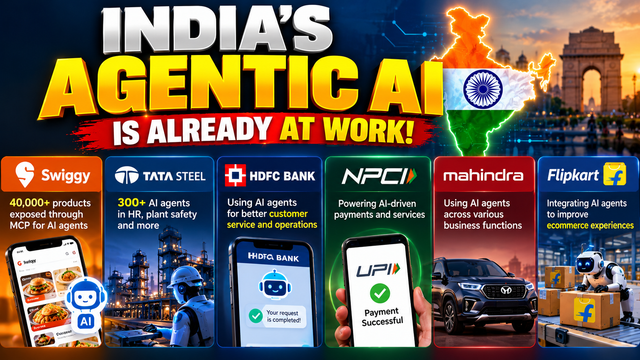
India’s next phase of AI adoption is moving beyond chatbots and copilots into systems that can actually perform tasks. A new report published by Express Computer on October 5, 2026 highlights how companies including Swiggy, Tata Steel, HDFC Bank, NPCI, Mahindra and Flipkart are putting agentic AI into real business workflows.
Unlike a traditional chatbot that mainly answers questions, an AI agent can interpret a user’s intent, connect to enterprise systems, access approved data and APIs, reason through multiple steps and take action within defined limits.
One of the clearest examples comes from Swiggy. The company has connected Food, Instamart and Dineout with AI assistants through the Model Context Protocol, or MCP. More than 40,000 Instamart products are exposed through MCP, allowing compatible AI assistants to search products, compare options, build carts, apply offers, place orders and track deliveries. This creates a new model in which the AI assistant can become the interface while Swiggy’s infrastructure handles the actual execution.
Tata Steel is taking agentic AI into industrial operations. According to the report, the company has deployed more than 300 specialised agents across areas including HR, customer support, safety and maintenance. Its digital assistant handles a large share of routine HR requests, while other AI systems are being used to identify plant-floor safety risks and support proactive maintenance.
Financial services are also becoming an important area for agentic AI. HDFC Bank is developing an enterprise platform around technologies including MCP and agentic systems, while payment companies are exploring agents for failed payments, disputes, abandoned carts and other operational workflows.
Mahindra is using agents in manufacturing as well as customer interactions, while Flipkart’s Super.money is exploring autonomous agents that can shop or make purchases according to rules set by customers.
The bigger shift is that AI is becoming an execution layer rather than simply an information layer. Instead of asking an AI what should be done and then doing it manually, users can increasingly delegate defined tasks to agents.
However, greater autonomy also creates greater responsibility. Agents that can access business systems or move money need strong identity controls, permissions, spending limits, audit logs and the ability to stop or revoke actions.
India has an advantage because its digital ecosystem already includes UPI, Aadhaar, APIs and other large-scale digital infrastructure. As these systems become accessible to governed AI agents, Indian businesses could increasingly build software around capabilities that agents can invoke rather than applications that humans must operate directly.
The rise of agentic AI therefore represents more than another AI trend. It could change how Indian consumers interact with businesses and how companies automate everyday operations.